

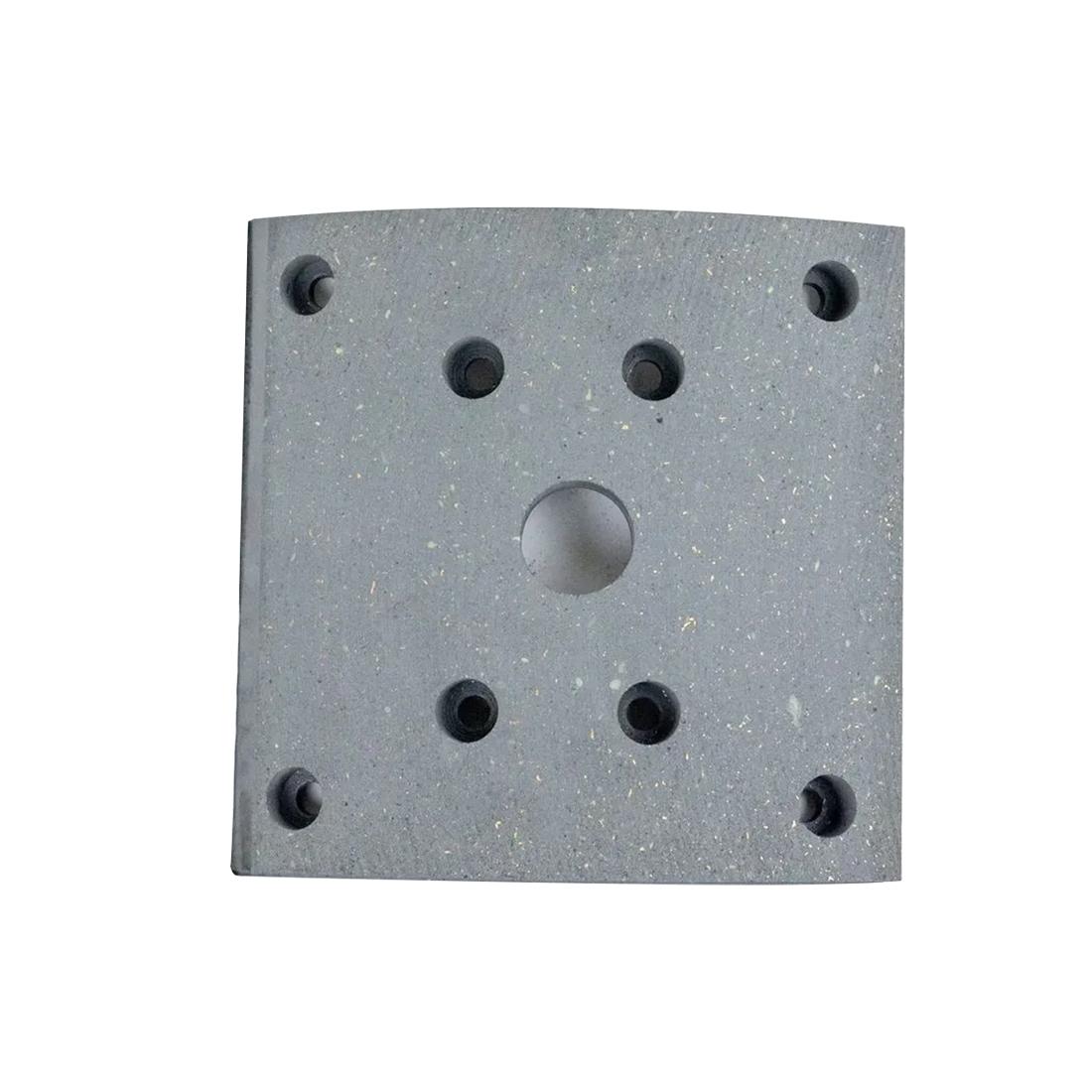
 The material of brake pads is the core factor determining their braking performance, service life and suitable scenarios. The formula and composition differences of different materials will directly affect key indicators such as the coefficient of friction, high-temperature resistance, noise and dust. At present, the mainstream brake pad materials are divided into three categories, and their performance influences are as follows:
1.Metal-based brake pads (semi-metallic/low-metal formula)
Core components: steel fiber, ferroalloy powder, copper fiber (traditional formula) + phenolic resin + filler, with metal components accounting for 30%-60%.
Performance impact:
Advantages: Stable coefficient of friction (0.35-0.45), strong braking force, medium heat resistance (able to withstand 400-600℃), low price, suitable for mid-to-low-end fuel-powered family cars and commercial vehicles.
Disadvantage: Metal materials have strong thermal conductivity and can easily transfer heat to the brake discs and calipers. Long-term high temperatures may cause the brake discs to deform. When braking, it makes a lot of noise and generates a large amount of black metal dust, which is prone to contaminating the wheel hub. The braking feel is rather hard at low temperatures.
Compatible scenarios: Economy cars, vans, pickup trucks and other cost-sensitive vehicle models.
2. Ceramic-based brake pads
Core components: Ceramic fiber, mineral fiber, graphite + high-performance resin, no metal or low metal content.
Performance impact:
Advantages: The coefficient of friction is stable (0.38-0.48), and its high-temperature resistance is superior to that of metal brake pads (able to withstand 600-800℃), with a slight thermal fade phenomenon. The braking noise is extremely low, with almost no metal dust and will not contaminate the wheel hub. It has low thermal conductivity, which can protect brake discs and calipers and extend the service life of brake discs. The low-temperature braking response is fast and the feel is smooth.
Disadvantages: The peak braking force is slightly lower than that of metal brake pads, and the braking confidence is slightly weaker when driving under heavy load or aggressively. The cost is 30% to 50% higher than that of metal brake pads.
Compatible scenarios: Family sedans, SUVs, new energy vehicles (suitable for low noise and low dust requirements).
3. Carbon-ceramic/carbon fiber brake pads
Core components: carbon fiber, silicon carbide ceramic matrix + special resin, belonging to high-end composite materials.
Performance impact:
Advantages: Extremely strong heat resistance (able to withstand 800-1200℃), no obvious thermal fade after continuous sudden braking; It has an extremely high and stable coefficient of friction (0.45-0.55), and strong braking force. It weighs only one third of metal brake pads and can reduce the unsprung mass. The service life is up to 80,000 to 120,000 kilometers, which is 2 to 3 times that of traditional brake pads, and it hardly wears out the brake discs.
Disadvantage: The cost is extremely high, being 5 to 10 times that of ceramic brake pads. In low-temperature environments (below -20℃), the coefficient of friction slightly decreases, and the initial braking feel is relatively soft. Occasionally, there is a slight abnormal noise when braking lightly at low speed.
Adaptation scenarios: High-end performance cars, sports cars, high-performance versions of new energy vehicles (such as Tesla Model Y high-performance version), racing cars.